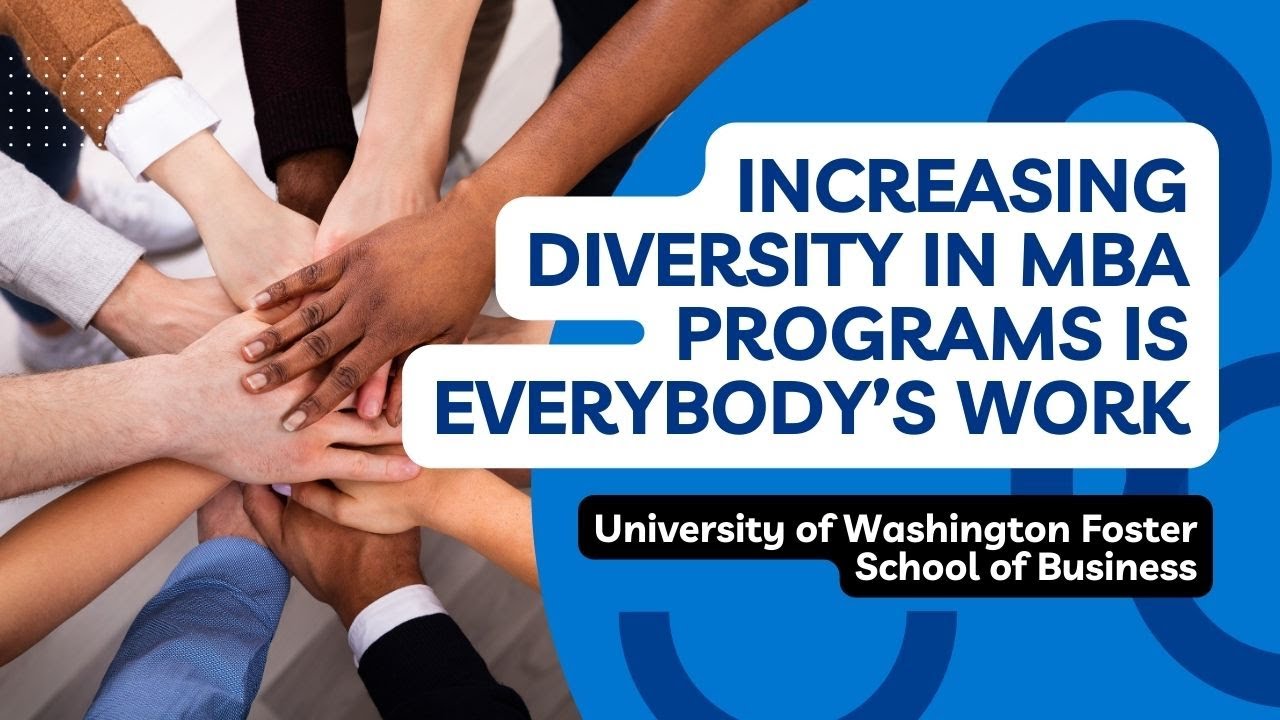
Many MBA programs prioritize diversity in recruitment to improve their students’ experiences and to produce the diverse leadership businesses need. Businesses with diverse executive and management teams consistently outperform less diverse companies. Increasing diversity means accepting students with a wide range of characteristics, especially from underrepresented minority (URM) groups.
Some characteristics like race and gender can relate to physical and visible differences. Others, like sexual orientation, religion, and ethnicity, can be invisible but still form an essential part of an individual’s identity.
Noé Valdovinos, Associate Director for Diversity Recruitment for the MBA program at the University of Washington Foster School of Business, looks for a similarly broad range of characteristics among candidates.
“When we think about underrepresented and minorities at the UW, we consider five ethnic minority groups, and that’s Black, Latino, Southeast Asian, Native American, and Hawaiian/Pacific Islander. In addition, what we also consider underrepresented are women, members of the LGBTQIA+ community, as well as veteran students.” (05:00)
Recruiting from a varied mix of MBA candidates is a great first step. However, a diverse population needs more to become a cohesive community. Diversity initiatives work best as part of a holistic effort to create an environment where individuals can thrive regardless of their background. Simply making choices to increase diversity without also creating an equitable and inclusive environment can negatively impact members of an underrepresented group. That’s why discussions about increasing representation increasingly refer to diversity, equity, and inclusion (DEI).
In an equitable environment, students have equal access to opportunities and an equal chance to succeed. In an inclusive environment, differences are welcomed, and everyone can participate and contribute. Together, they create a healthy environment for URM students and their peers.
Organizations must truly integrate DEI into their culture to have a meaningful impact. As Noé says, “diversity is everybody’s work.” (03:00) Through the Fostering Diversity initiative students, prospective students, alums, outside organizations, faculty, and staff are encouraged to contribute to the Foster community.