What Is It Really Like Studying for an MBA in the Netherlands?
With a diverse and inclusive approach to business, the Netherlands has become a top study destination for international MBA students in recent years. There are a lot of unique advantages to studying in the Netherlands. For one, the country offers a vast range of top-tier, affordable, English-taught programs.
As a nation, rankings consistently place the Netherlands among the best English-speaking countries in Europe and globally. It is well-known for its multicultural population, strong work-life balance, focus on sustainability and innovation, and high quality of life. In fact, the Netherlands ranks #1 in Numbeo’s Quality of Life Index 2026.
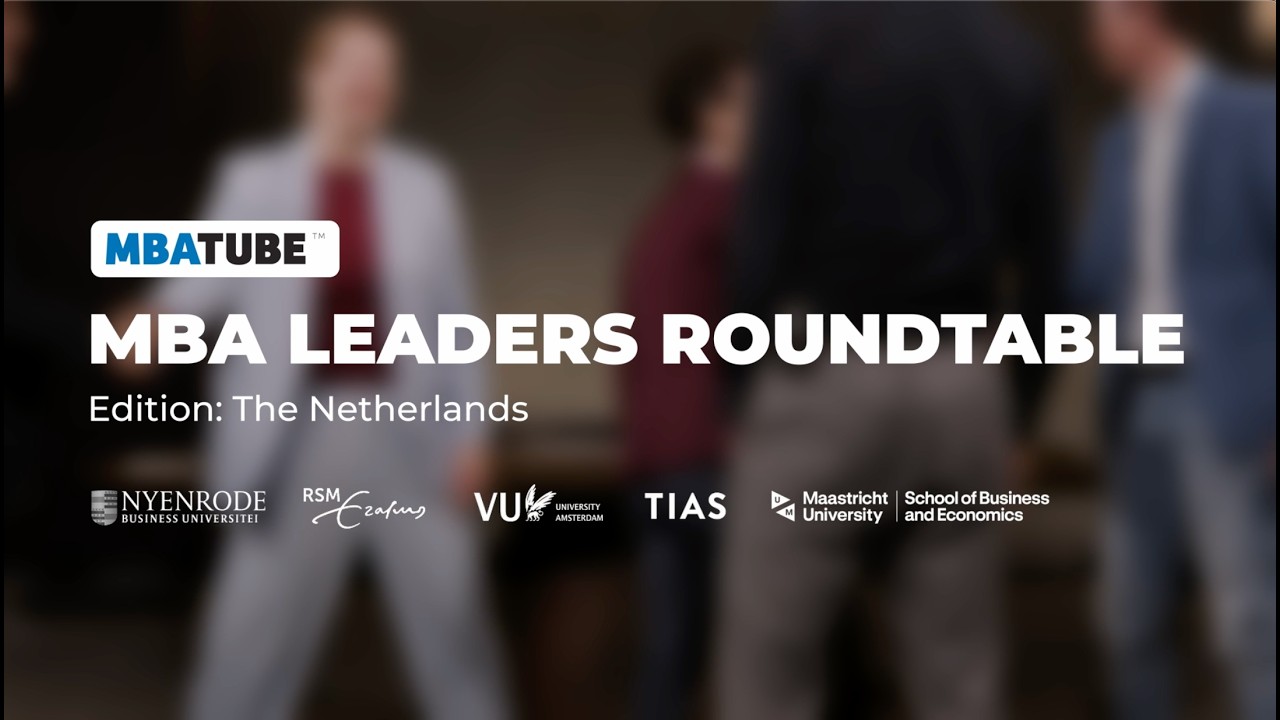
MBAGRADSCHOOLS met with MBA Directors from five of the top business schools in the Netherlands for an MBATUBE: MBA Leaders Roundtable to ask them what makes studying for an MBA in the Netherlands such a pivotal experience. This included Vrije Universiteit Amsterdam, Maastricht School of Management at Maastricht University, Nyenrode Business University, the Rotterdam School of Management at Erasmus University, and the TIAS Business School. They shared their expert insights on how to gain true value from an MBA and what makes a business education in the Netherlands so unique.
The Dutch MBA Approach: Self-Reflection & Personal Growth
Dutch business schools have a unique approach to the MBA program. While each school has its own strengths in ethos and teaching approach, there are broad overlapping themes in many Dutch business school MBA programs. Beyond the business fundamentals like marketing, strategy, management, and finance, there is a strong emphasis on ethical leadership and personal development.
Firstly, who is the typical MBA student at a Dutch business school? The MBA Director of the International Business Program, Lalin Anik, from Vrije Universiteit Amsterdam shares, “Often MBA students, and Executive MBA students, come to us at a plateau. There’s a change. There’s something that has slowed down in their life. And they’re looking for that next thing, and they’re curious. They’re hungry. They might be a little stuck. They’re looking for these opportunities.” (06:55)
In response, the Dutch MBA approach is one of self-reflection and personal and professional growth.
Lalin further adds, “They come with questions, wonderings, uncertainty. I think our job is partly to get them to slow down and realize you have what you’re looking for within you. We’ll give you the framing of it, the direction, [and] the questions to explore that and a space to slow down.” (08:20)
Many global MBA programs often throw around buzzwords such as “transformational” and “life-changing”. But what, in practicality, does growth and transformation in an MBA entail?
MBA Director Ron Jacobs at Maastricht University has a simple explanation: “What happens in an MBA journey usually is that they find out a lot more about themselves… they raise their own self-awareness and self-efficacy. So they become more efficient in doing what they do and also more effective. They become more effective leaders.” (10:00)
Director of Management Degree Programs Berber Van Norden at Nyenrode Business University insists, “I always do find that an MBA gives confidence at the end of the journey. If it’s academically or personally, because you know what you’ve grown towards, you know what you want your destination to be, and you know that you have the right tools at hand.” (11:02)
Many Dutch business schools interweave personal development, self-reflection, and leadership training into their MBA programs. Education here delves beyond textbook knowledge. Rather, what these Dutch business schools have in common is the belief that personal and professional growth are two sides of the same coin.
Mindset is Key for Your MBA in the Netherlands
Additionally, MBA programs in the Netherlands focus on community-building, exposure to new opportunities, networking, and peer-learning. Business schools call this “experiential learning” or “hands-on learning”. This type of learning is action-based and skills-focused.
At their core, MBA programs aim to prepare students for the future. Students learn to find “non-textbook solutions” and how to make systemic changes in the world around them. Berber says, “With the current challenges that we have ahead of us – geopolitical tensions, AI – the students need to be prepared for whatever the world throws at us next.” (13:51)
The programs typically provide tools and frameworks. Often, not every tool or framework suits every student. Students therefore learn to make tools and frameworks their own, learning when to apply them, adapt them, and how to use them authentically.
Lalin explains that true learning involves thinking, acting, and feeling as sources of knowledge. “Using all your senses, integrating your mind with your heart, your body, and your intuition to make sense of the world.” In addition, Berber describes this as a “hearts, heads, and hands” approach. (14:48)
In the end, an MBA challenges you to think differently. Oftentimes, MBA students arrive searching for answers, but the MBA will generate new questions. “Thinking differently is also knowing that you don’t have to have the right answer. You have to know how to get to that answer, maybe with the help of others,” Ron offers. (16:15)
According to this roundtable, it is this mindset shift that is the essence of an MBA and is unattainable elsewhere.
The MBA Cohort as an Ecosystem: The Power of Co-Creation
The true value of an MBA program comes from the interpersonal relationships and community built. An MBA program leads to a lifelong community, friendships, and business connections that extend beyond the classroom. As a global port and relatively small country, the Netherlands has always had a strong focus on internationalization. This ensures that MBA classrooms are diverse and multicultural spaces that mimic the complexity of the real global business world.
At its core, an MBA program is an act of co-creation. Students learn from each other as much as they learn from their professors. MBA students bring their previous academic education and work experiences into the classroom. This creates a rich ground for peer-learning.
Ron says, “I would love students to think about: ‘Who is sitting next to me?’ instead of ‘What am I getting, how does the curriculum look like, or what kind of elements do you teach?’” (24:27) He defines the MBA classroom as a multi-layered and complex ecosystem.
The MBA cohort is all part of this ecosystem. They co-create the learning experience, shaping their learning journey together.
Ron (Maastricht University) adds, “There’s a lot to learn from others that you would normally never meet.” (25:12)
Dutch MBA programs offer exceptional diversity in student academic backgrounds, nationalities, cultures, sectors, and industries. For instance, RSM, from Erasmus University, boasts a highly diverse class profile. RSM ranks 100% for ‘International Students’ and #3 globally for ‘International Mobility’ in the Financial Times MBA 2026 Ranking. Its International Full-time MBA 2027 cohort comprises 28 nationalities.
MBA Director Jochem Kroezen from the Rotterdam School of Management at Erasmus University adds that peer-learning requires a proactive approach within the classroom. Students should consider “What can I contribute?… We are looking for student[s] who can help us collectively do better.” (25:23)
Some of the most important and unique aspects of an MBA include expanding your worldview, learning to work in diverse teams, cross-sector peer-learning, and diversifying your network.
Flat Hierarchies Lead to Greater Dialogue
Dutch communication styles are infamously direct, authentic, and open.
Ron jokes, “[In the Netherlands,] it is flat as well. Not just geographically, but also the hierarchies within organizations. Also, I mean if you look in the [MBA] programs, you can notice that students find it odd sometimes that you can simply call your professor, and that also opens up the conversation that creates a different level of energy and dialogue.” (43:25)
MBA students can speak openly with their peers, teaching assistants, and professors. Dutch MBA classrooms tend to encourage debates and individual critical thinking. This pushes students to be active, lead, and challenge the status quo. This directly contradicts a top-down approach that fosters passive learning.
In turn, the candidates who get the most out of their MBAs are always the most curious and engaged. Jochem (RSM) believes that students also need to arrive ready “to be surprised… that means [that] you need to constantly be open and also accept the friction that comes.” (20:16) This requires a degree of willingness to step beyond their comfort zone.
Students in Dutch MBA classrooms can expect classroom discussions, team assignments, presenting to the class, and hands-on projects. Professors expect students to take initiative, delegate tasks within their teams, and organize their own planning.
This can initially confront international students, particularly those used to formality in the classroom, more hierarchical structures, and independent studying. However, once the culture shock subsides, it is one of the greatest advantages of studying an MBA in the Netherlands.
Straight Talking, Broad Thinking: The Dutch Approach to Learning
The Netherlands stands out for being welcoming, open, and outward-looking. Beyond that, the Netherlands’ multiculturalism helps students to become more open-minded. Benito Giordano, the Director of the MBA Program at the TIAS Business School, says, “The Netherlands is a fantastic backdrop for that because it’s not just [about] profit maximization.” (17:56)
The natural focus on sustainability in the Netherlands is palpable. Many Dutch businesses take a holistic approach to business, blending ethics and social responsibility with profit.
Benito expands, “The number of bicycles, the solar panels, the recycling, and the way in which urban planning [is organized]. Just for [MBA students] to be part of that, it’s like an osmosis; doing an MBA in other parts of the world, I’m not sure you get the same insight.” (18:29)
Lalin describes the Dutch mentality as a “roots in the ground” approach. Berber explains that the Netherlands, as a small country, has had to adapt, build trade relations with international partners, and has always been a vessel for multiculturalism. In that sense, the Netherlands has an inherently entrepreneurial mindset. (40:53)
The Netherlands has a long history of business leadership. The Amsterdam Stock Exchange (AEX) was founded in 1602, making it the world’s oldest stock exchange. It is now part of Euronext Amsterdam. In today’s market, the Netherlands leads in top industries such as water systems and maritime industries, agriculture, energy, technology, and creative industries, among other sectors. Despite its small geographical size, the Netherlands is the second-biggest exporter of agricultural produce globally, after the U.S.
Moreover, despite its small size, the Netherlands ranks among the best English-speaking countries in the world. Additionally, people born abroad make up about 16.8% of the entire population.
Lalin shares, “As an immigrant myself, it is a very welcoming land. And most of our education is still in English, which opens the doors and is accessible.” (42:03) She adds, “It’s truly a melting pot.” (42:33)
48,139 new international students enrolled in higher education in the Netherlands for the 2025-2026 academic year. The Netherlands continues to attract a large number of international students. Particularly from countries such as Germany, Italy, Spain, Romania, and Belgium.
Jochem elaborates, “It’s a really rare place these days where we have that openness, that cosmopolitan mindset, and that rich diversity. Not just in nationality but also in terms of backgrounds that we can bring into the classroom.” (42:36)
For international students who are not planning on staying in the Netherlands, it is a ‘port to the world’ for those who want to travel and work within Europe.
Dutch Business Schools Bridge Academia and Industry
Beyond that, Dutch business schools play an important role in bridging the gap between a range of industries and academia.
Benito notes about the Dutch education system: “There’s a lot more collaboration with adjunct faculty and guest speakers, whether it’s healthcare, tech, or banking. That we bring them into the classroom, we talk to them, and I think there’s less of an academic divide between academia and business. I think we play a really key role in that, and that’s how things are done in the Netherlands.” (49:07)
A Small Country With Strong Company Connections
Dutch universities are increasingly focusing on connecting with businesses, companies, and employers to link academia and industry. This helps both local and international students network with potential employers and meet industry leaders within the Netherlands. As a small country, these connections can go a long way in career-building.
Benito elaborates, “Increasingly engaging with companies, whether it’s internships or projects… trying to do more of that, to give our students not just the academic rigor, but also that exposure to professional connections and building on the strength of the Dutch economy.” (36:03)
Ultimately, this is what divides traditional universities from business schools. Business schools connect research with current business industry trends. For instance, many MBA programs include a live consultancy project or business project with a company.
Experiential Learning Brings Concepts to Life
Jochem describes, “There are so many different ways in which you can create experiential learning, right? So, increasingly we work with simulations in the classroom, there’s constant teamwork, and we have coaches. The experience needs to be as rich and diverse as possible so that it can cater to many different learning needs.” (38:23)
Lalin adds, “We take you to different contexts. In Amsterdam, we go to the museum to talk about leadership… [we] go to a Michelin-starred restaurant to talk to a chef… we take our students to different places.” (38:39) It is these unique experiences that prepare graduates for any industry and set the MBA apart from an MSc or other types of master’s programs.
Hands-on, experiential learning is central to the MBA experience in the Netherlands. Many programs blend theory with practical exercises. This way, students gain real-world business experience through consultancy, internships, and live company projects.
Which Skills Are Dutch Business Schools Teaching?
From the perspective of Dutch MBA directors, the most important ‘21st-century skills’ that business schools are fostering include leadership, human-centric management, navigating uncertainty, resilience, and adaptability.
Additionally, skills are at the forefront of every employer’s mind. There is a significant skills gap between recent graduates and employer expectations. But which skills are in-demand in the Netherlands?
For one, Dutch-language skills, remarks Benito. (30:14) Employers in the Netherlands are increasingly making Dutch language skills part of their job description.
International students are asking for better support from Dutch universities to learn Dutch. This broadens their opportunities in the Dutch job market. Many universities in the Netherlands are also adapting their teaching to foster cross-cultural exchange and smooth integration.
Jochem explains, “We deal with students that come from the other side of the world sometimes, [which adds] cultural distance as well, and they hope to bridge that within a year. But that remains a consistent challenge, right? Can they really live up to sort of the expectations that you find in the Dutch workplace?” (31:07)
Dutch business schools are also increasingly focusing on meeting employers’ expectations on new technologies and AI.
On the other hand, Ron says, “I think this human aspect of how we teach, how we educate, how we engage with our students to really build those personal skills, and leadership skills [these] are becoming more important because of it.” (32:41)
AI skills are the new buzzword, yet human connection, creativity, and sound judgement are growing in importance as a result.
Ready to do an MBA in the Netherlands? Here is Some Advice From MBA Directors Themselves
Does an MBA in the Netherlands sound like something for you? In this MBATUBE: MBA Leaders Roundtable, five MBA Directors share their advice for your MBA journey.
Be curious, engaged, and willing to show up. Stay open and look around you as well as inside you. Naturally, there will be some friction points throughout the course of the program. Accepting those growth points with vulnerability positions you to get the most out of an MBA.
Moreover, Ron explains, “[It’s not just about] coming to class and then trying to get out the maximum possible and then get back to work again.” Jochem agrees, “I mean that’s being a consumer, right? You need to show up also as co-creators.” (21:07) Ultimately, those who take ownership of their learning journey make the most of the experience.
An MBA helps you build new skills and expands your network, but more importantly, it reshapes you to effectively tackle any uncertainty you encounter in the future.
At the end of the day, a new job title, rankings, or accreditations do not define an MBA journey. It is a profound experience and a long-term investment in yourself and your future. As Lalin says, “What’s the investment you’re willing to make for an authentic version of you?” (56:44)
Learn more about studying in the Netherlands.